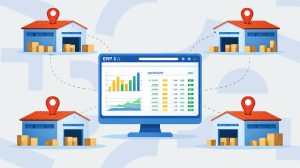
Opening a second warehouse often feels like a sign of progress. More space. Better reach. More room to support growth.
In practice, it usually changes more than businesses expect.
A second site does not simply mean holding more stock. It changes how stock moves, how teams communicate, how purchasing decisions are made and how reporting needs to work. What used to be manageable in one location becomes harder to control across two.
That is where multi warehouse ERP becomes important.
Our ERP is built to keep stock, purchasing, sales, dispatch and reporting connected across locations. That matters because as soon as inventory is spread across multiple warehouses, the business needs more than two sets of stock records. It needs one shared view of what is where, what is available, what is on the move and what that means for the wider operation
Why adding a second warehouse creates operational pressure
The first warehouse usually develops its own rhythm.
Teams know where stock is kept. Buyers understand reorder patterns. Warehouse staff can often solve small issues through experience and routine. Once a second site is added, that familiarity starts to break down.
Now the business has to manage stock by location, not just in total. Teams need to know whether goods are in warehouse one or warehouse two, whether they are available to sell, whether they are already allocated, and whether a transfer is needed before an order can be fulfilled.
That is when warehouse expansion challenges begin.
The problem is not only extra stock. The problem is extra coordination. A second warehouse creates more handovers, more opportunities for mismatch and more pressure on the systems holding the data.
What usually breaks first
When a company adds a second warehouse, the first thing that often breaks is visibility.
The total stock figure may still look right, but the location detail starts to go wrong. One site may have too much stock while another runs short. A product may exist in the business, but not in the place where it is needed. Sales may see availability in total without fully seeing where that stock sits.
That creates friction quickly.
Transfers become more frequent. Purchasing becomes less clear. Warehouse teams spend more time checking stock positions manually. Management starts asking more questions about what is actually available and where.
This is exactly why our integrated inventory approach focuses on managing multiple locations with one clear view of stock rather than separate records by site.
Why spreadsheets get exposed even faster
A second warehouse often reveals weaknesses that were already there.
If a business is still relying on spreadsheets, side notes or disconnected records, those methods become much harder to manage across two sites. The issue is not simply having more rows in a file. The issue is that each movement between locations now needs to be recorded accurately and reflected in the right place at the right time.
That is where delays and duplication start to enter the process.
One team updates the stock position. Another team works from an earlier version. A transfer is physically completed but not reflected in the system straight away. A buyer places an order because one site looks low, even though the other site could have covered demand.
This is why a second warehouse often forces a bigger question about process. If stock control still depends on separate files or manual updates, the business is no longer just managing stock. It is managing uncertainty.
If that is already happening, it helps to understand how an ERP system connects inventory and operations. A core feature of ERP is the shared database model, where multiple departments work from the same underlying data instead of reconciling separate systems later.
How our ERP helps maintain control across two warehouses
Our ERP helps by keeping both warehouses inside one connected process.
Stock is recorded by location, but visibility stays central. Teams can see what is held in each warehouse, what is moving, what is allocated and what still needs action. That makes it easier to manage transfers, replenishment and fulfilment without relying on guesswork.
That improves control in several practical ways.
It becomes easier to see where stock actually is before promising it to a customer. It becomes easier to move stock between warehouses in a more controlled way. It becomes easier to avoid duplicate purchasing when inventory exists elsewhere in the business. It becomes easier to report on stock and performance without pulling information together manually from each site.
That is one of the real strengths of multi site operations ERP. The value is not just that there are two warehouses in the system. The value is that both sites feed one process instead of creating two separate versions of the truth.
You can see the same principle in stock control with real-time visibility and integrated inventory management across the organisation. Both focus on keeping stock connected, visible and easier to manage across the wider business.
Why a second warehouse affects more than stock
Businesses sometimes treat a second warehouse as a storage change. In reality, it affects much more than that.
Purchasing decisions become more complex because demand and availability now need to be understood across multiple locations. Sales needs clearer visibility into where stock is held. Finance needs reporting that reflects movements and stock values accurately. Management needs confidence that expansion is adding control, not just more moving parts.
That is why multi-site growth puts pressure on the whole business, not just warehouse teams.
The real goal is not more space. It is maintained control.
A second warehouse should make the business stronger, not harder to manage.
That only happens when the added complexity is matched by better visibility and better structure. Otherwise, the business gains more storage space but loses clarity.
Our ERP is built to support growth like that by keeping stock, transfers, purchasing and reporting connected across locations.
When both warehouses feed one system, the business becomes easier to control.
When each site starts developing its own records and workarounds, delays and duplication follow.
That is why multi warehouse ERP matters. It helps businesses expand operationally without losing grip on stock, reporting and day-to-day decision-making.
FAQ
- What is multi warehouse ERP?
Multi warehouse ERP is an ERP system that manages inventory, transfers, purchasing and reporting across more than one warehouse in one connected platform. - What usually breaks when a company adds a second warehouse?
Stock visibility is often the first thing to weaken. Businesses start struggling with location accuracy, transfers, duplicate purchasing and slower reporting. - How does multi site operations ERP help?
It helps by keeping both sites in one system, so teams can see stock by location, manage movements more accurately and work from one shared view of operations. - Why do warehouse expansion challenges affect more than stock?
Because adding a second warehouse changes purchasing, fulfilment, reporting and decision-making across the whole business, not just storage capacity.